How to Play
Koi-Koi is a matching and capture game played with a 48-card Hanafuda deck. You are trying to capture cards that form scoring combinations (called yaku). The first to a higher total across the chosen number of rounds wins the match.
Match structure
- A match is a fixed number of rounds, chosen in Options (1 to 12).
- Each round produces an award for one player, or a draw.
- The player with the higher total score after the last round wins the match. Equal totals are a draw.
- A misdeal is not counted as a round.
The cards
The deck has 48 cards in 12 months of 4 cards each. Cards come in four types. Here is every card of each type, so you can learn them by sight:
| Type | Count | Notes | Cards |
|---|---|---|---|
| Brights | 5 | The most valuable cards. Used for the Bright yaku. |      |
| Animals | 9 | Includes the Sake Cup (09-A). |          |
| Ribbons | 10 | Some are Poetry (red) or Blue ribbons, which form special sets. |  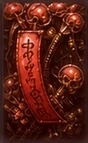 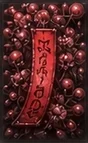 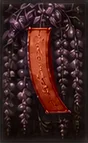       |
| Plains | 24 | Mostly worth points only in bulk (Kasu). |                         |
The Sake Cup (09-A) is an Animal, and it forms the Hanami-zake and Tsukimi-zake sets with the Curtain and the Moon (not in Tournament or Yakuza). The Rain Man (11-B) is a Bright, but it is not a wild card. See Cards for the special cards.
Here is one full month — January (Pine). All four share the same month, so any of them matches any other January card on the field:
January: Crane (Bright), Poetry ribbon, and two Plains.
Face-down cards (your opponent's hand and the stock) show the card back:

Matching is by month only. A card matches any field card of the same month. Card art, type, and name never decide a match. The Rain Man, Sake Cup, and Lightning cards are not wild.
Matching examples
Same month: capture. You play the January Crane onto a field that holds a January Plain. The months match, so both cards go to your pile:
played + on the field → capture both
Different month: no capture. You play the same January Crane onto a field that holds a February Warbler. The months differ, so nothing is captured and the Crane stays on the field:
played + on the field → no capture
Full card list: Cards.
Setting up a match
Oya-gime: who deals first
Before the first round, each side picks from two face-down cards. The card with the earlier month wins the deal. If the months are the same, the higher card type wins (Bright over Animal over Ribbon over Plain). The winner is the dealer and plays first.
After the first round, the winner of the previous round deals. If the round was a draw, the dealer stays the same.
Dealing
- 8 cards to you, 8 to the CPU.
- 8 cards face-up on the field (the table).
- 24 cards face-down in the stock (the draw pile).
Misdeals
If the field starts with all four cards of one month, or with exactly four pairs, the deal is void. The round is redealt with the same dealer, and the redeal is not counted.
Lucky hands
After a valid deal, the game checks each hand for a lucky opening:
- Teshi: all four cards of one month in your 8-card hand.
- Kuttsuki: four pairs in your hand (two of each month, four months).
| Lucky hand | Your 8-card hand looks like | Result |
|---|---|---|
| Teshi (four of one month) | Four January cards: plus any four other cards |
6 points |
| Kuttsuki (four pairs) | Two cards of each of four months: Jan · Feb · Mar · Apr |
6 points |
A lucky hand wins the round immediately for 6 points, with no multipliers, and that player becomes the next dealer. If both players are lucky, the round is a 0–0 draw (except in Yakuza, where both players lucky is not a draw — the dealer wins 6 points (dealer privilege), see Yakuza).
Both are checked only once, on the 8 cards dealt at the start of the round.
Taking a turn
Each turn has two stages, and you always do both: a hand stage, then a stock stage.
| Stage | Where the card comes from | Who picks it |
|---|---|---|
| 1. Hand | Your 8-card hand | You, face-up, on the table |
| 2. Stock | The top of the face-down stock | Nobody. It is turned over at random |
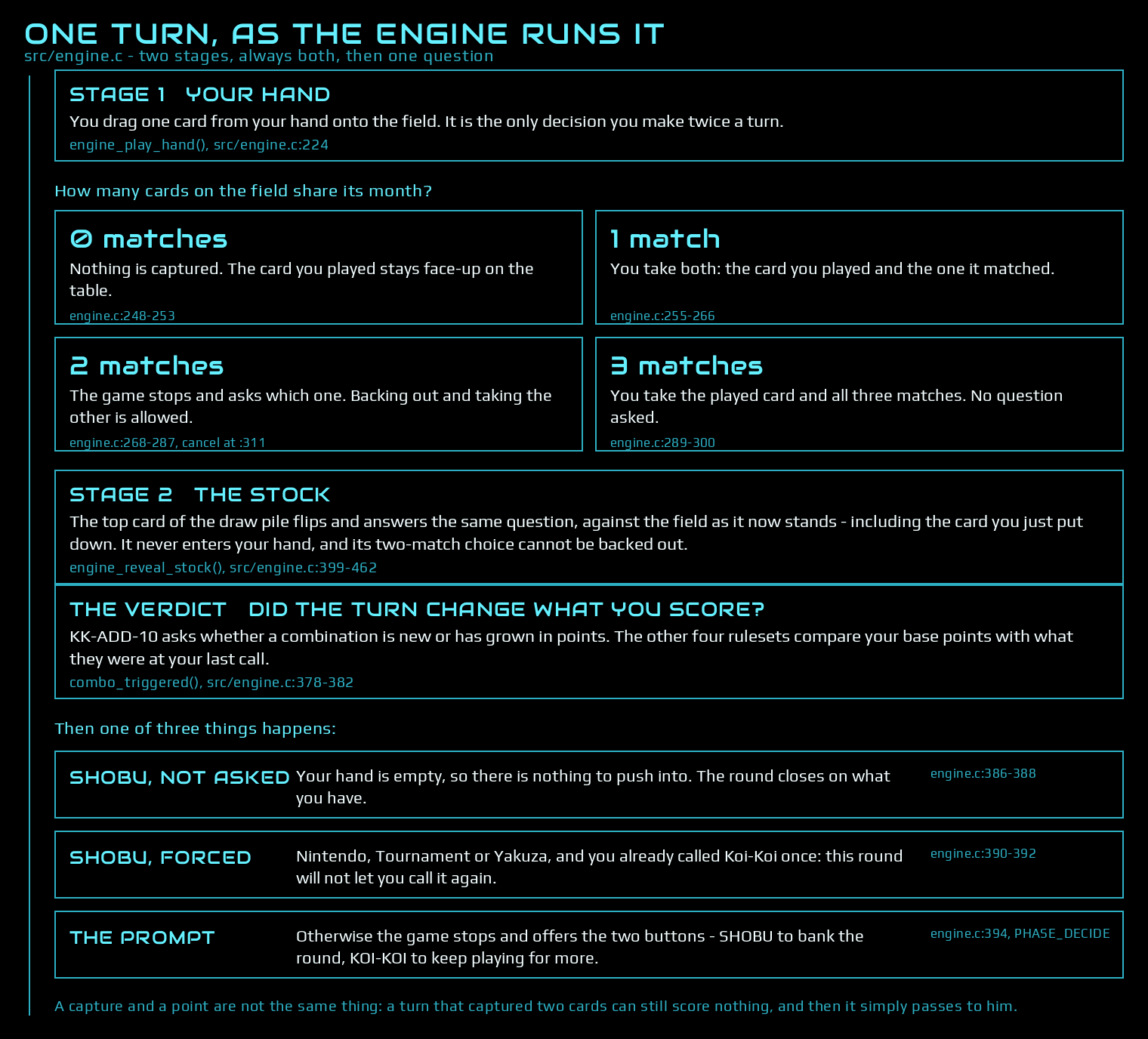
A worked turn, in two steps (the field starts with a January Plain and no February card):
- Hand stage. You play the January Crane from your hand. The field holds a January Plain, so you capture both: + go to your pile.
- Stock stage. The top stock card is turned over: → . The field has no February card, so the Warbler stays on the field.
Stage 1: play a card from your hand
Pick a card from your hand and play it onto the field:
| Field matches for that card's month | What happens |
|---|---|
| 0 | The card is placed on the field. Nothing is captured. |
| 1 | You capture the played card and the matching field card. |
| 2 | You choose which one of the two matching field cards to capture. |
| 3 | You capture the played card and all three matching field cards. |
If a card has a match, it must capture. You cannot put it down on the field while a match is available. You may play a non-matching card even when another of your cards would match.
Stage 2: draw from the stock
Reveal the top card of the stock and apply the same rules against the updated field. This includes the card you just played, if it landed on the field. The stock card never enters your hand.
If the stock card has two matches, you must choose one. You cannot cancel.
Scoring the turn, and calling Koi-Koi or Shobu
After both stages, the game scores the cards you have captured this round.
- If your score has gone up since your last call this round, you are asked to choose:
- In KK-ADD-10, the question opens when a combo is new or has grown in points instead — see KK-ADD-10.
- Shobu (stop): the round ends and you score the award.
- Koi-Koi (continue): play carries on, and you aim to score more. Your Koi-Koi call is recorded for the round.
- If your score has not gone up, there is no prompt and play passes to the other player.
- If you have no cards left in hand, Koi-Koi is not offered and the round ends automatically with your Shobu.
- Some rule sets force a Shobu after your first Koi-Koi call. See each rule set page.
Example: calling Shobu or Koi-Koi. You capture the January Crane, the March Curtain and the August Moon. None of them is the Rain Man, so together they form Sanko (Three Brights). Under KK-ADD-10, Sanko is worth 5 points (see the Yaku table). Your score went up from zero, so the Koi-Koi screen opens:
→ Sanko, 5 points → choose Shobu to end the round and score 5, or Koi-Koi to play on and try for more.
Calling Koi-Koi is a bet. Each of your Koi-Koi calls raises your own multiplier, and the opponent calling Koi-Koi doubles your award if you win. See Multipliers.
Ending a round
The round ends in one of these ways:
- Shobu. A player stops and scores the award.
- A lucky hand (see above).
- Exhaustion. Both hands are empty and nobody called Shobu. This is a 0–0 draw and the dealer stays the same.
After a round, the results screen shows each yaku, the base points, every multiplier, and the final award.
Controls
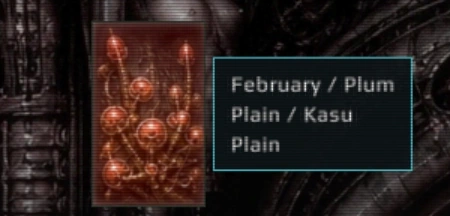
What a hover says: month and suit, type and its Japanese name, and the card's own name. The row is
only armed on Easy (src/ui_main.c:569), and face-down cards cannot be described at all - a card
registers itself for the tooltip as it is painted face-up (src/ui_board.c:179) and the back
painter cancels the candidate by passing -1 (:187).
- Play a card: drag a card from your hand onto the table, or click it once to select it, then click a matching field card. If it has no match, click an empty part of the field to place it. When two cards match, click the one you want; when three match, all three are captured. Small pointer movements still count as a click.
- Selected card: the card and its matching field cards stay outlined. Click another hand card to change selection; click the selected card again, right-click, or press
Escto cancel. This click-selection outline works on every difficulty. - Inspect combos: click CPU COMBOS or YOUR COMBOS in the right column. The detail window shows completed combos, their points and cards, the base total, and current multipliers. Use NEXT / PREVIOUS for additional combos. CLOSE,
Esc, orPresumes play; the CPU, animations, and turn timer stay paused while the window is open. The award preview is what that side would earn if it banked now, not points already awarded. The small panels show shortened previews; the window has the full names. - Choose a target: when a choice appears, click the card you want to capture. Some choices can be cancelled, and the stock choice cannot.
- Pause:
P, orEscwhen no card is selected or being dragged. - Easy difficulty: hand cards that can capture glow, and while you drag a card, field cards of the same month glow to help you match. Hover over a face-up card for half a second to see its month/suit, type (including its Japanese name), and card name beside the cursor. This also works on captured cards and cards in choice overlays; face-down cards never reveal metadata. Tooltips disappear when you leave the card, drag, pause, or switch away from Easy difficulty.
Winning
Each round's award goes to the round winner. Points accumulate across the match, and the highest total at the end wins. The match result screen records the round-by-round ledger.
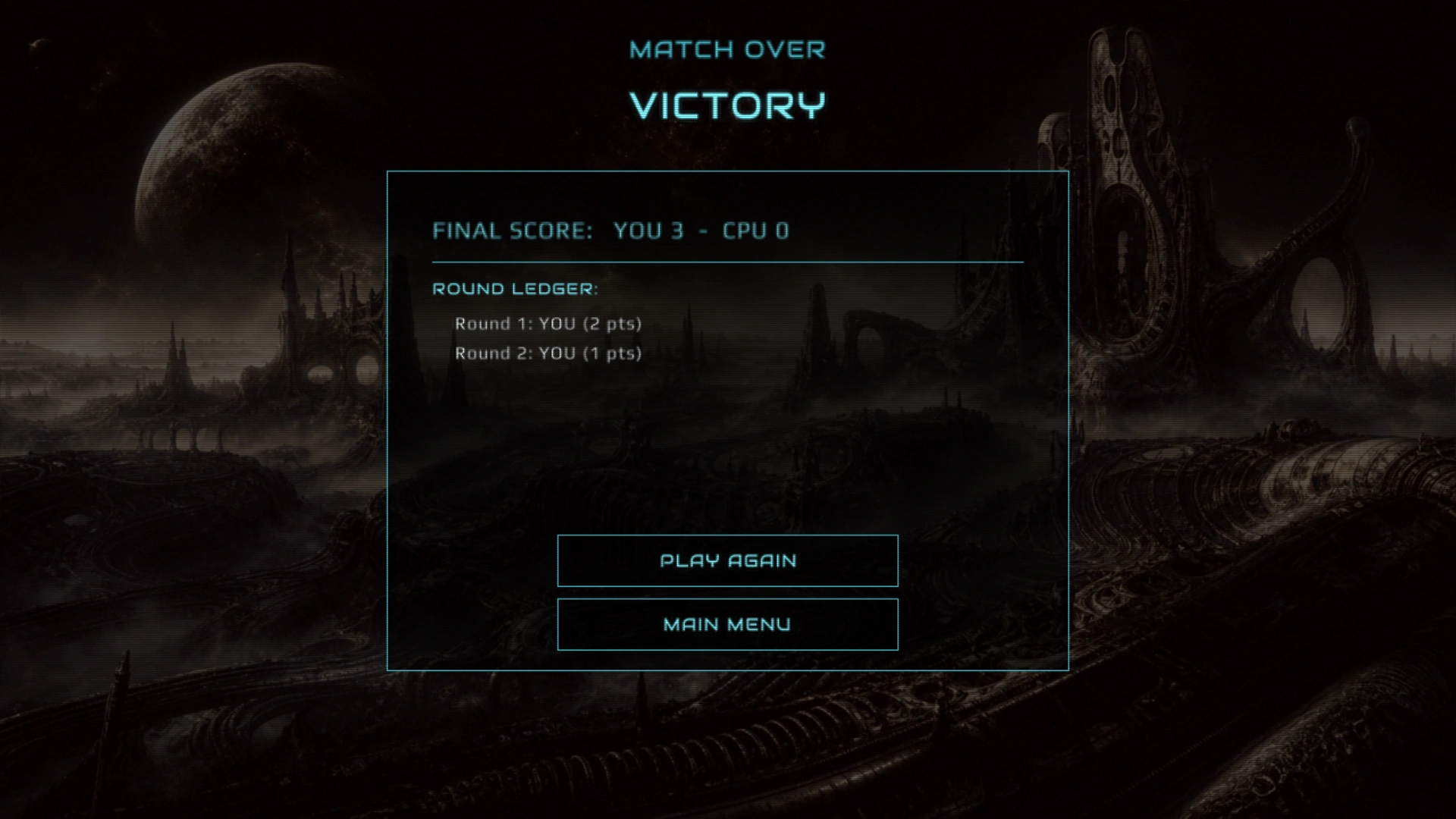
A 3 - 0 win over two rounds. The ledger is per round, not per turn, which is why the numbers are small even in a match where you captured half the deck each round.
Next steps
- Want it shown instead of described? Play it in three turns walks one round, card by card.
- Choose a rule set: Rulesets
- Learn what each combination scores: Yaku & Scoring
- Understand how multipliers stack: Multipliers
- Play through the campaign: Opponents and Modes